A New BBL Is on the Rise
ulhmts on 02 December, 2025 | No Comments
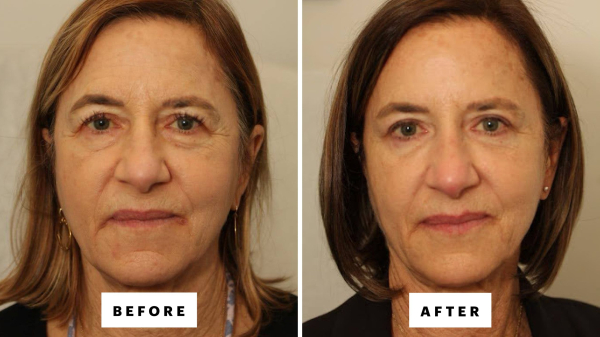
 Courtesy of Dr. Robert SchwarczSave this storySave this story
A Nefertiti Lift, the Mommy Makeover, Traptox—the aesthetics world loves a catchy name for a surgery or treatment. But none has ever entered the zeitgeist quite like the BBL (full name: Brazilian Butt Lift). Today, however, that posterior-enhancing procedure is getting a post-bad-press rebrand (“fat grafting to the butt” is less snappy, also less tainted)—and there’s a new BBL all over your social feeds and TV screens (whether you realize it or not). This time the letters stand for Blepharoplasty Brow Lift. With rising demand for less invasive surgeries and subtly impactful results, plastic surgeons say they are performing more and more of this eye-opening surgical combo. There’s also been speculation that this BBL is the reason why certain celebrities are suddenly appearing quite refreshed.
“The goal now is invisible intervention. If it’s obvious, it’s considered bad work,” explains Luis Macias, MD, a double-board certified plastic surgeon in Marina del Rey, California. And done well, a blepharoplasty brow lift will leave a patient looking (and feeling) well-rested, but not dramatically different. The scars left behind are less noticeable, too: Brow lift incisions are hidden in the hairline and those from an upper blepharoplasty are tucked within the eyelid crease. “The scars can be quite undetectable and possibly more palatable for someone under public scrutiny,” says Raj Dedhia, MD, a double-board certified facial plastic surgeon in San Francisco.
The general population has gotten the memo, too: Blepharoplasty, or removal of excess skin around the eyes, was among the top five most popular plastic surgery procedures in the US in 2024, according to the American Society of Plastic Surgeons' most recent report. Brow lifts are far less common—13,621 in 2024 vs 120,755 blepharoplasties—but some surgeons say that gap is narrowing. “I now do them together almost all the time,” says Daniel Gould, MD, PhD, a board-certified plastic surgeon in Beverly Hills. And that wasn’t the case five years ago.
“A lot of patients who come in thinking they just have ‘extra eyelid skin’ actually have a brow position problem and an eyelid problem happening at the same time,” says Dr. Gould. “When you only treat one and ignore the other, the result can look incomplete or even a little off. Treating them together tends to produce something more balanced and more natural. I think surgeons are getting better at recognizing the relationship.”
We spoke with several facial plastic surgeons about what a blepharoplasty brow lift entails, the best approaches to the surgery, and what they really think about this increasingly popular plastic surgery two-for-one.
Breaking Down the Blepharoplasty Brow Lift
“A blepharoplasty rejuvenates the eyelids by removing excess skin, refining or repositioning fat, and restoring the natural contour of the lids,” says Dr. Macias. There are two different types: upper and lower. Lower blepharoplasties (or blephs, as they’re often called) can help minimize chronic puffiness and undereye bags (and are increasingly sought out by people in their 20s and 30s for that reason). But when we’re talking about this new BBL, we’re talking about an upper blepharoplasty.
During an upper bleph, a strip of skin is removed from the upper eyelid. Sometimes, depending upon a patient’s anatomy, fat in the surrounding area will be removed to enhance the result, helping to alleviate heaviness and hooding of the eyes. Conversely, if someone has a hollowed appearance, whether genetically or due to aging or weight loss, fat can be added back to the area for a more natural result. “In the upper eyelids, [if necessary], we can move fat from near the nose to fill hollowing above the eye,” says Dr. Gould.
“When it’s done well, an upper bleph helps to open up hooded eyelids, and bring back the lid space for applying eye makeup,” says Catherine Weng, MD, a board-certified facial plastic and reconstructive surgeon in Wayne, Pennsylvania. When excess skin and fat in the upper eyelids are so severe that they obstruct peripheral vision, an upper blepharoplasty can actually be medically-necessary (and covered by insurance).
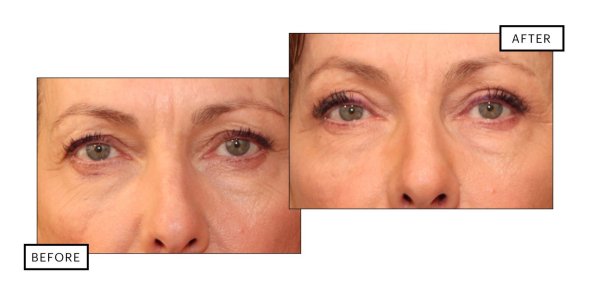
Before and after a bleph brow lift, as performed by Dr. Dedhia.
Courtesy of Dr. Raj Dedhia
Now, onto the BL in the new BBL: That’s a brow lift—though many of the surgeons we spoke with said that “brow lift” is kind of a misnomer. ”A brow lift is commonly misnamed because it’s not really a lift, it’s a reset,” says Dr. Gould. (But BBR just doesn’t have the same ring to it, does it?) Though they refer to the same thing, calling it a brow reset versus a lift is an easier way for patients to understand that it’s “not just about lifting [the brow] to the sky, but rather raising and contouring it to a more natural position,” says Robert Schwarcz, MD, a board-certified oculofacial plastic surgeon in New York City. Ultimately, a brow lift/reset should soften heaviness in the upper third of the face.
“I always have patients bring in photographs from 20 years ago. l look at the position of their brow, and I try to reset it as close to that,” says Dr. Schwarcz. For patients who are young enough that a 20-year-old photo may showcase their first day in kindergarten, Dr. Schwarcz often recommends an upper bleph alone to address their concerns about heaviness around the eyes—though he says he will, rarely, see patients under 30 with genetically lower brows who could benefit from a brow lift.
There are several different surgical approaches to the brow lift. “The key distinction in brow lifts is both where the lifting occurs and how you lift,” explains Lyle Leipziger, MD, a board-certified plastic and reconstructive surgeon and chief of plastic surgery at North Shore University Hospital and Long Island Jewish Medical Center. The “where” preferred by most of the surgeons we spoke with is laterally—meaning behind the hairline, near the temples—and the “how” is endoscopically. Dr. Macias says the combination allows for natural adjusting of the brow without distorting other areas of the face. Through those small, hidden incisions, a scope is placed beneath the muscle to reposition the tissues. Surgeons say this approach leaves the most minimal scarring, as opposed to techniques like the trichophytic brow lift (wherein an incision is made along the front hairline) or direct brow lift (with an incision along the forehead). Another option, the lateral temporal brow lift, addresses the outer part of eyebrows and is used for patients who only want the most subtle lift. As with a lateral endoscopic lift, incisions are made in the hairline to hide scarring.
Why a Bleph and Brow Lift Are Often Better Together
While both surgeries can certainly be performed alone, together they refresh the upper face and eye area in totality—which makes anatomical sense because “the brow and upper lid function as a unit,” says Dr. Gould. “When the lid feels heavy, the brain will often recruit the frontalis—the forehead muscle—to help lift the brow and open the eye.” This connection matters a lot operatively: If upper eyelid skin is removed in the wrong patient, it can cause an elimination of that compensatory drive and cause the brow to settle lower afterward. “[If this occurs] the patient’s upper face looks flatter, heavier, and sometimes less expressive in motion,” says Dr. Gould.
When determining if a blepharoplasty brow lift is right for a patient, Dr. Dedhia evaluates anatomy above all else. “Age alone is not the determining factor,” he says. However, Dr. Schwarcz says that he typically performs the BBL on people in their 30s and 40s. “Beyond that, I tend to perform it along with a facelift.” Because the eyelids don’t age alone, “addressing midface drooping often creates the truly smooth, youthful transition patients want,” he says.
Done well, the BBL “opens the eyes and restores a gentle arch to the brow without screaming ‘surgery’ because the incisions are hidden,” says Dr. Dedhia. “Patients look less tired, less angry, and more ‘awake’ but people can’t quite put their finger on what changed.”
The Gender Difference in a Bleph Brow Lift
A general rule of aesthetics (at least in 2026) is that less is more—and even less than less is better when it comes to men and this particular surgical duo. “The surgery is not gender specific, but the aesthetic targets are,” says Dr. Dedhia. Men’s brows tend to be flatter, whereas women’s brows tend to have more of a rise and fall.
Because men's brows typically sit at or slightly below the brow bone, “too much of an arch can quickly feminize the face,” explains Dr. Dedhia. “I’m very conservative about brow elevation in male patients.” Dr. Schwarcz agrees: “I very infrequently raise the brows on men. It has to almost get to the point where they can’t see [before I’d do that].”
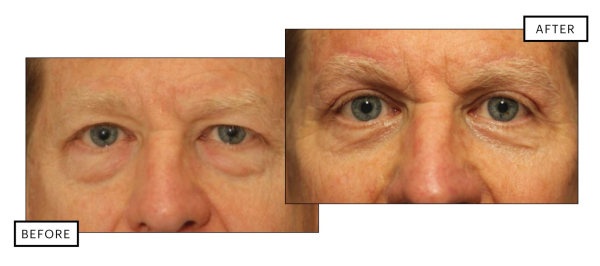
A rare instance when a bleph and brow lift, as performed by Dr. Schwarcz, were appropriate for a male patient.
Courtesy of Dr. Robert Schwarcz
Raising the brows on a man can trigger what Dr. Schwarcz refers to as a transition between “hunter versus prey.” “For men, there’s a concept of ‘hunter eyes’ versus ‘prey eyes.’ Men [tend to] like that sort of more mysterious hunter eye look,” he says. “One male celebrity in particular who got it wrong is an example of going from a hunter to a prey look. [The prey] look can occur when fat is taken out from the upper eyelid, creating a hollowed out, doe-eyed look.”
“Hunter eyes” versus “prey eyes” is not a concept that plastic surgeons are taught in medical school—Dr. Schwarcz picked it up from his son. “I overheard my teenage son and his friends talking about it a few years ago. Around that time I started seeing a few younger male patients request a more ‘hunter eye’ look as well.” Ever since, he says, “I have since incorporated it into the lectures I give at medical conferences to other doctors. In essence, they are asking for a more masculine, heavier brow with a full upper eyelid appearance.”
In the event the opposite happens, fat can be placed back into the upper eyelids between the brow hairs or the crease of the upper eyelid to hide incisions. In general, Dr. Schwarcz says that having more fat and heaviness in the eye area is seen as more masculine—so if a blepharoplasty (versus a brow lift) on a man is even appropriate, it should be done with a light hand. “I avoid fat and muscle reduction and leave a natural overhang,” he says.
The aesthetic target for women is not as black and white. “Some prefer a subtle, soft lateral arch; others want a very low-key, almost straight brow but without heaviness,” says Dr. Dedhia. “Across all genders, [it’s important to] respect the patient’s baseline anatomy and identity.”
Things to Consider Before a Bleph Brow Lift
After a combined upper bleph brow lift, patients should expect visible swelling, bruising, and scalp numbness for one to two weeks. “Most patients are publicly presentable somewhere around 10 to 14 days,” says Dr. Gould. Because soft tissue takes time to heal, expect full results between three to six months post-surgery.
The surgeons we spoke with typically perform a combined upper bleph and brow lift under general anesthesia or intravenous sedation. However, if the procedures are done separately, Dr. Dedhia says he will perform a bleph under local anesthesia. For solo endoscopic brow lifts, he prefers to use twilight (also known as IV sedation) or general anesthesia. Dr. Leipziger will perform a brow lift under local anesthesia, but only “if it’s a simple lateral brow lift to raise the arch of the brow.”
Risks of a Bleph Brow Lift
According to the surgeons we spoke to, the risks of a combined bleph brow lift can include bleeding, bruising, infection, scarring, dry eye, sensory changes, and swelling for weeks or months. Brow lifts—solo or paired with a bleph—carry a small but real risk of facial nerve weakness and localized hair loss at and around the incision site. Upper blephs on their own add risks such as temporary difficulty closing the eye, lid malposition, and light sensitivity.
Relatively common and particularly bothersome—albeit temporary—post-operative symptoms are headaches and migraines. Headaches typically occur due to pressure and tightness from soft-tissue tension and swelling, says Dr. Gould. If a patient is predisposed to migraines, surgery can be a trigger. For most patients, it’s more like a dull headache that lasts for a few days.
Cost of a Bleph Brow Lift
Your final bill for a bleph brow lift depends on many factors including geographic location. According to the American Society of Plastic Surgeons, the average cost of an upper bleph is around $3,000 to $5,000; a brow lift is in the range of $4,000 to $7,500. Bear in mind, these are only the surgeon’s fees and do not include anesthesia or facility fees—and that in certain markets like Beverly Hills or New York City, the cost of the surgery is well above the national average. “When you combine them, the total isn’t simply additive in most practices,” says Dr. Gould, adding that there is some cost savings in that the double procedure only requires, for example, one operating room and one anesthesiologist.
Final Thoughts on the New BBL
Unlike the old BBL, this version of the acronym is not designed to turn heads or have a sizable impact. It’s about rejuvenating, not reconstructing. “You’re not chasing every line—you’re correcting specific anatomic changes that are making the eyes look heavy, sad, or tired,” Dr. Dedhia says. “The goal is not to erase age or chase a social-media face; it’s to restore harmony and light back to the eyes.”